Tag: Lifestyle

  • Forty and Fabulous!

    Forty and Fabulous!

    – Ijay Dogo celebrates a life of grace

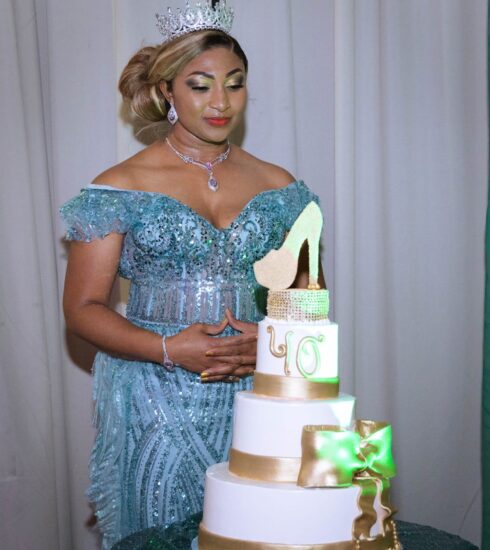
    It was all glitz and glam on September 17, 2022, in Aurora Colorado during the fortieth birthday bash of the ever-gorgeous Ijeoma Dogo, fondly called Ijay.

    People arrived from within and outside Colorado to celebrate the blessed mother of three beautiful children and the wife of a businessman. The large reception hall was breathtaking in gold with a swanky ambiance. The celebrant made three separate entrances, disappearing and returning after each round of dancing in a new change of clothes. As she dazzled in her resplendent flow-train dresses, one could see that the birthday lady is really fabulous at forty. 

    Her father and mother were there all the way to complete her joy. Her husband, Vince Dogo, and their three kids beamed with joy. Other relatives and close friends came from near and far to celebrate her. Guests came from everywhere to honor the birthday girl. Ladies came decked in gold while men came in their freestyle, as had been announced. Food was in its assortment; music was tremendous and guests had so much fun.

    Asked why she celebrated, Ijay said, “Forty is a good number to celebrate. The Lord has helped me through many hurdles and I wanted to appreciate God in a loud way. This is in addition to some of my friends, convincing me to celebrate myself.”

    Asked what she would have wished for, Ijay revealed that It would have been nice to have her siblings with her, “but that was beyond my control, other than that, I wouldn’t change anything.”

    Afrik Digest further asked if she regretted anything in her forty years on earth, she said, “I don’t think so. I always try to do my best in whatever I find myself doing. What I have achieved so far is my best. I have no regrets!”

    Ijay is grateful to her amazing parents, family and friends. She thanks her cousin, Rosemary, and her kids; her auntie, Chika Onyema from Atlanta, and Ezra Onyema from Oklahoma. She further expressed her appreciation to everyone who helped in one way or another before, during, and after, to make the party successful.

    Afrik Digest wishes Her Fabulousness an amazing new age.

  • Flattering hairstyles that suits the shapes of your face

    Flattering hairstyles that suits the shapes of your face

    FLATTERING HAIRSTYLES THAT SUITS THE SHAPES OF YOUR FACE

    Looking for the most flattering hairstyle for your face can be a long, hard journey, but consider this: there is no one-size-fits-all hairstyle for any given face shape. The beauty of African American hair is that it can be worn in so many ways: curly, kinky, wavy, relaxed, braided, twisted, and so on. You shouldn’t feel limited by your face shape if you want to experiment. Here are some examples of flattering hairstyles for your face shape that you might find useful.

    Oval


    An oval face shape hairstyle has been said to be the most common of them all with a middle part being complementary to this face shape because of how it showcases symmetry while highlighting features whether it’s with a straight or curly or braided hairstyle.

    Round 

    For round-faced girls, it can be a struggle to achieve the sleek hairstyles of our oval or oblong-shaped friends. However, with a side part, you can add dimension to your face and elongate your shape with a high-swept bang. These details can be paired with a pixie cut or an updo. Believe it or not, they draw attention to your jaw, cheekbones, and hairline and create a longer face shape to match that of the ovals and oblongs.

    Square
    Square

    Curls and waves are a go-to for this face shape and it’s easy to see why. Sometimes the chiseled bone structure of a square-shaped face can use a little softening. And a wavy short cut or long bouncy curls will help you achieve just that. Particularly, if the features are sharp, curls or waves are a sure-fire way to take the attention away from a defined jaw.

    Heart

    If your face is widest across the forehead, coming to a sharp point at the chin, your lovely shape is that of a heart. Whether blunt, textured, or side-swept, bangs can hide the forehead’s length and/or depth, and draw attention to the eyes. Elongate your face with wavy long locks or accentuate your pointed chin with a jaw-length bob. You could even rock a half-up style and frame your face while also drawing attention away from your forehead.

    Diamond

    Diamond-shaped faces, though usually small in size, can make just as much of a statement. Pulling all of your hair back or to one side highlights your hairline, jawline, and chin. 

    Oblong

    Last but not least, the oblong face shape has versatility written all over it. A middle part can be balanced by long or medium cut waves. And if you’re going for a shorter look, feel free to add texture when clipping your ends. 

    Ultimately, if there’s a style you want to try, go for it! You only live once and there are plenty of wigs that need good homes. But if you’re on the fence, and looking for something a bit more calculated/well-proven, use this list as a user guide for your next hair move

  • Congolese Singer, Juvelly, is not apologizing for self-love

    Congolese Singer, Juvelly, is not apologizing for self-love

    CONGOLESE SINGER, JUVELLY, IS NOT APOLOGIZING FOR SELF-LOVE

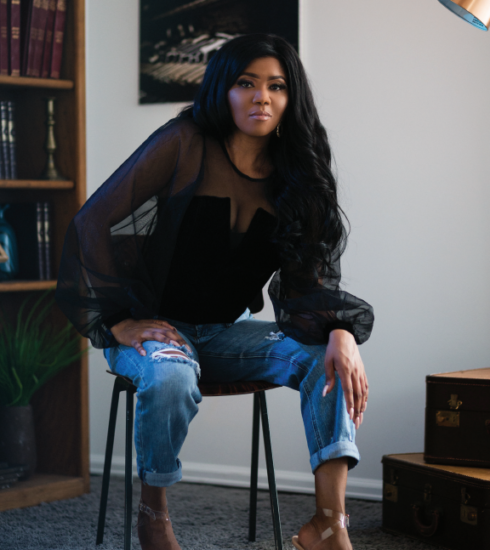
    Juvelly is a singer and songwriter. Originally from Congo, Juvelly and her family relocated to the United States when she was only 12. She is the eldest of four siblings.

    Juvelly started singing at the young age of nine when joined a choir at a friend’s church in Congo. Over the years, she continued to sing in the church and alongside her father, who is also a gifted musician and songwriter. Over time, she kept a journal of her music and recorded the melodies every time she had an inspiration.

    “My father told me to make sure I record and write it all down so as not

     to lose it. Due to stage fright, I’ve mostly kept quiet about my talent except in church. So only close friends and family knew that I could sing and write songs,” she says.

    Juvelly defines her music as ‘a note to self’ and this notion is reflected in the title of her debut album, Yoka, which means ‘Listen’ in her native Lingala. She sings Congolese Rumba or just Afrobeat.

    “My music is mostly a reflection of self; both painful and happy lessons of life. My music is to encourage others, to help those that are struggling with their emotions and to tell them that, although it may seem like all is lost, to not give up on ourselves,” she says.

    She cites that the drive to express herself via music is spurred by a desire to be heard.

    “I’ve never felt heard in my life. Juvelly is known as the life of the party kind of girl and it stops at that. No one took the time to get to know the real me, someone who struggled to get up at times in the morning; who cried and needed a shoulder to lean on.

    “If I complained or acted out my emotions, I was seen as being negative. This pain really played a big part in my songwriting over the years. I just wrote all my emotions down. Music has been therapeutic to me and helped me cope with many bottled emotions that I couldn’t express to others. I feel free when I write it all down.”

    For the artist, the process of putting her thoughts on paper and sharing them with the world has made it easier for her to overcome her deepest fears. Juvelly’s music is mostly inspired by her lived experiences- rejection, depression and a realization that she needed to learn to let go and trust God. She notes that being an African woman means that her struggles are different from those of other women- an issue that she confronts in her music.

    Juvelly says writing and recording her own music has helped her grow as a person and she is now a confident woman who refuses to apologize for being herself.

    “That really gave me the strength to push my music career forward to where I am.” She hopes that her music will reach out to those that can relate to her message of hope and self-love.

    “My mission right now is just going with the flow and seeing what’s in store for me. Currently, I am just focused on continuing to write and record all that I always wanted to say now that people are listening. My vision is that I touch a life every day through my music and inspire others to make a bold move and to realize their self-worth.”

    When she is not writing or recording, Juvelly loves to enjoy time with her family, kids and close friends. She loves to read articles and world news, especially about Africa in an effort to keep abreast with the continent that she loves and misses. She is also a foody and loves trying different cuisines.

  • South Africa

    South Africa

    SOUTH AFRICA

    South Africa is located at the southern point of Africa. During the seventeenth century, Dutch colonists from the Netherlands (known as Boers) settled there. Over the next 200 years, British, French, and German settlers joined them. At first, they settled along the coast, but eventually settlers moved inland. These settlers developed a unique cultural identity and language and became known as Afrikaners. Their language, Afrikaans, began as a spoken dialect, but developed into a written language, too. Over the next 300 years, the Afrikaners battled indigenous (native) African peoples. established independent republics in the interior, and fought the British in two wars known as the Anglo-Boer Wars. All territories were finally united on May 31, 1910, to become the Union of South Africa. (The Republic of South Africa was established fifty years later on May 31, 1960). In 1910, there was a clear division between the Afrikaners (who belonged to Afrikaner political parties, spoke Afrikaans, supported Afrikaner cultural and linguistic endeavors, and belonged to one of the Dutch Reformed Churches) and British-oriented, English-speaking South Africans. In 1948 the Afrikaner-based National Party came to power. Under a strong religious philosophy and racist social policy, the National Party started to implement the system of apartheid. Apartheid separated the people of South Africa by law along color lines. By the 1980s, there were many Afrikaners who joined the effort to do away with apartheid.

    Food in Our Culture

    The everyday meal of the Afrikaner is characterized by an emphasis on meat, starch, and cooked vegetables. Green or fresh salads are rare. Breakfast features some kind of porridge. Away from the coast, Afrikaners learned from the native peoples to make a gruel called stywe pap or putu pap (stiff porridge or putu porridge). It is common to have this porridge for breakfast with milk and sugar, and also to eat it with meat or boerewors (boer sausage, made of beef and pork) at a braai (barbecue). Venison has always formed part of Afrikaner dishes, as grazing animals could be hunted or culled from national parks. Sosaties (skewered marinated meat similar to shish kebab) is frequently included in a braai . A recipe for bobotie , another favorite dish accompanies this article. Fish has become popular for those living near the ocean. Two foods from pioneer days are still popular among Afrikaners: beskuit and biltong . Beskuit (rusks) are biscuits that have been oven-dried. They are served with coffee. Biltong are strips of dried meat (traditionally, beef or venison; more recently, elephant and ostrich). The biltong are treated with salt, pepper, and spices prior to drying.

    Potjiekos

    Marriage in Our Culture

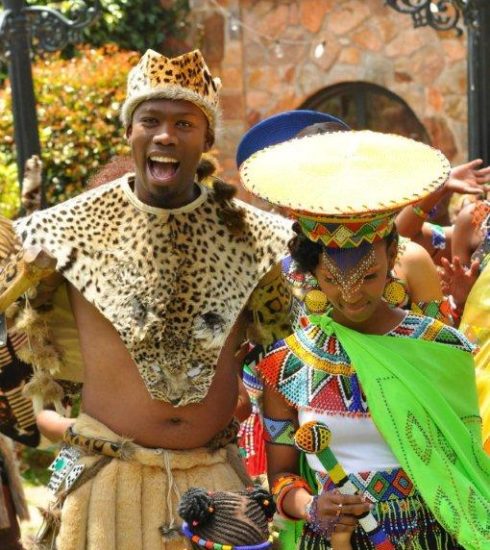
    Pre-Christian marriage in black communities was based on polygyny and bridewealth, which involved the transfer of wealth in the form of livestock to the family of the bride in return for her productive and reproductive services in the husband’s homestead. Christianity and changing economic and social conditions have dramatically reduced the number of men who have more

    than one wife, although this practice is still legal. Monogamy is the norm in all the other groups, but divorce rates are above fifty percent and cohabitation without marriage is the most common domestic living arrangement in black and Coloured communities. Despite the fragility of marital bonds, marriage ceremonies are among the most visible and important occasions for sociability and often take the form of an elaborate multisited and lengthy communal feast involving considerable expense.

    Source: Everyculture