Author: Austin Okigbo

  • Burning History and Heritage: the problem of africans’ cultural self-immolation

    Burning History and Heritage: the problem of africans’ cultural self-immolation

    BURNING HISTORY AND HERITAGE: THE PROBLEM OF AFRICANS’ CULTURAL SELF-IMMOLATION

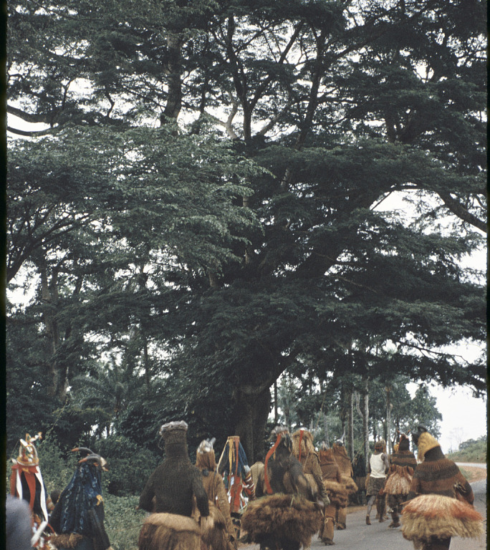
    A few years ago, I was invited to Michigan State University as a guest lecturer at a summer institute that was funded by the National Endowment for the Humanities (NEH). In my lecture and workshop, I made the case that African music and the arts in general comprise historical transcripts and archival encoding of African worldviews, aesthetic ideals, and values and sensibilities. I recall some of the Americans present challenging my ideas as to how many ordinary Africans have the same appreciation as I do about the value of African arts beyond their ritual and recreational uses. Fast forward to 23 September 2021, the Nigerian writer Chimamanda Ngozi Adichie, while speaking at the Humboldt Forum in Berlin, Germany, called out European nations to return the artifacts they looted from Africa as part of the colonial projects. Chimamanda rightly observed that “art lives in history and history lives in art. Much of what we call African arts are also documents, they tell African stories.” While acknowledging that they are sacred and hold spiritual values, she indicated that they “speak to the dignity of the people, to their worldview and to their aspirations.” She pushed back against what has become a dominant Europeans’ argument that African nations lack the capacity to care for the artifacts. I have read and heard that argument a lot in a lot of academic forums, and I was always offended to say the least, especially because the argument should have been preceded by the question of how Africans created and cared for the artifacts, many of which were more than a thousand years old before they were looted.

    The good news is that, after decades of being cajoled by African scholars, and roughly a month after Chimamanda’s speech at the Humboldt Forum on 29 October 2021, NBC news reported that Jesus College at Cambridge and the University of Aberdeen in Scotland have returned famous bronze arts, including the head sculptor of an Oba of the Ancient Benin Kingdom. The bad news on the other hand, is that a careful look at what is happening on the continent especially in Nigeria, may afford merit to the argument that

    Africans lack the ability to care for the artifacts. When I say, “what is happening on the continent,” I mean a lot of the destruction of history that is going on by pastors of new-found pentecostal churches in the name of “deliverance”. These modern-day seers have become notorious for cutting down trees that are hundreds of years old. Some of the trees are the remnants of their species which are already endangered, thanks to uncontrolled logging that began with the colonialists who exported timbers for the development of Europe’s infrastructure. Much later in post-colonial times, their subalterns carried on with the activities which has now resulted in deforestation and growing desertification. While the world is busy debating how to put a stop to the destruction of green reserves around the world for the sake of our healthy existence on this planet, Pentecostal pastors in Nigeria are busy seeing demons of misfortune and spirits of anti-progress in trees.

    The other issue is how churches, especially the Pentecostals (and sometimes even the charismatic movements in the mainstream churches such as the Catholic Charismatic Renewal Movement (CCRM) and the Evangelical Fellowship in the Anglican Communion (EFAC)) are in the forefront of destroying artifacts in the name of delivering families and communities from the demons and spirits of anti-progress. 

    A few months ago, I received from a friend a heart wrenching picture of a pentecostal pastor setting fire on an Ikoro in Uga, Anambra State, Nigeria. From my inquiry, the artifact in question is more than three hundred years old. Did the pastor understand the history of the instrument, its use and function in traditional society, and its meaning? Ikoro is a tuned wooden idiophone whose pitch inventory ranges from two to five. The nature of the instrument is significant in respect to its communicative function and ability to replicate the language of the people. Igbo is a tonal language that is also built on rhythm and quantity. It is for this reason that there are several instruments among the Igbo that are used for communication, so that anyone who is well grounded in the language and culture can decode the speech patterns performed on specific instruments. Perhaps the most extant reference to the use of ikoro to perform speech patterns among the Igbo is that written by Chinua Achebe in Things Fall Apart in which he described the announcement of the death of Ogbuefi Ezeudu. According to Achebe, one “of the things every man learned was the language of the hollowed-out wooden instrument” (1995:120). It is also in this light that western spectators came to call ukom, ikoro (also known as ekwe), dundun, and a host of other African instruments as talking drums.

    Ikoro is carved from the trunk of a tree by hewing in and thus creating a hollow in the trunk. The instrument is played with two mallets by hitting on different spots on the regions of the instrument with openings thus producing different pitches. The size of the instrument varies, and so the frequency of each depends on the intended density and spatial distribution of the intended audience. The largest sizes have lower frequencies and therefore can transmit across long ranges of space and time. Hence in Igbo villages, the ikoro is used to communicate messages of different sorts to the members of the community, namely to announce the death of a prominent member of the community; to summon the community to the village square for a meeting; to alert the community about a roaming wild and dangerous animal such as leopard; to alert them about an impending war; to summon people to come out to fight a raging fire; and to announce the emergence of the great spirit of the land in the form of a masquerade. Again, the communicative ability of the instrument consists in the fact of its ability to replicate speech patterns in Igbo. Hence an average Igbo person, especially adults, ought to master the language of the ikoro and to understand how to respond accordingly when the community is being summoned or being informed about an issue.

    Given the functional role of the instrument, communities normally built houses for it to protect it from the elements. Also, to prevent children and mischievous individuals from meddling with the instrument thereby causing unnecessary nuisance for the community, elders ascribe spiritual powers to the instrument and make believe that anyone not commissioned to play the ikoro would incur the wrath of the ancestors and the spirit of the land if they tried to play the instrument. In fact, the role of the ikoro in traditional Igbo society is much like the role of the toll bell in Medieval Europe which was tolled only by a designated civil servant to alert the community of a death by plague, raging fire, roaming wild animal, or bandits in the vicinity of the community. It is the toll bells that became the church bell, and which the European missionaries brought to Africa. Today in Europe, Africa, and Nigeria, no one operates the church bell unless you are a priest, deacon, or a commissioned lay minister, otherwise you may be charged for constituting a nuisance and desecration of sacred objects. Yet, it is the parallel instrument with a parallel function in society that a pastor is destroying.

    So many of such destructive acts are going unreported across Nigeria. They recall the actions of the Taliban and ISIS destruction of ancient artifacts in Afghanistan and Iraq respectively thereby finishing the work that Alexander “the Great” began in 330 BC. The vexing part of all the destructions going on now in Nigeria and other African countries in the name of born-again Christianity and deliverance from ancestral demons and spirits of anti-progress, is that it is happening while we are at the same time cajoling Europeans for stealing our artifacts and calling for their repatriation. So, if the European colonialists and missionaries who looted these artifacts had incinerated them, where or how would we be asking them now to return them? In fact, I give it to Europe for preserving these artifacts. At least when I go to Rome, I can still see and recognize the obelisk in the St. Peter’s Square in the Vatican as an African artifact which now stands tall with a cross on top of it. It served in Egypt as a sundial, and a solar symbol that represented a vital flow between heaven and earth, a way of communicating to the divine. It is taken by Emperor Caligula in 37AD. Today in the Vatican, it is a symbol of humanity reaching out to Christ (see http://stpetersbasilica.info/Exterior/Obelisk/Obelisk.htm). What a transformative reinterpretation. Yes, Europeans have been in the business of pillaging and looting African treasures since before the common era. So, it is not just the colonial loot that must be returned, even the Pope owes Africa an apology and repatriation of our artifact if I must say. The lingering question that Africans must answer however irrespective of how offensive it may sound coming from Europeans, is, can we keep and care for the things that belong to us? Yes, Europeans looted and stole African artifacts that tell our story, and speak to the dignity of our people, our worldviews, and our aspirations using the words of Chimamanda, yet it is debatable how these may survive the ongoing historical and cultural self-immolation in the name of religion.

    Austin C. Okigbo, Ph.D.

    Teaches Ethnomusicology and African Studies at the University of Colorado, Boulder.

  • Unknown Gunmen – Unknown Solders

    Unknown Gunmen – Unknown Solders

    A Familiar Language in the History of State Sponsored Violence in Nigeria

    Austin C. Okigbo

    In 1981 the Oracle of Afrobeat Fela Anikulapo Kuti released an album with his famous Afrika 70 titled Unknown Soldier under the Skylark label. The album was recorded in 1979 in the Phonodisk Studio in Ijebu-Igbo, Ogun State. That was two years after his shrine and residence famously known as the Kalakuta Republic was invaded and destroyed by Nigerian soldiers numbering up to a thousand as reported in the song by Fela. The song will come to be reckoned as his most emotional record given the carnage that the soldiers inflicted on the place and persons within on February 19, 1977. Fela’s mother, a political activist in her own right was thrown out of the window of a three-level house. She suffered injuries from which she never recovered until her death on April 13, 1978. The public outcry and broad condemnation of the violent act by the soldiers led the administration of then head of state, General Olusegun Obasanjo, set up a panel of inquiry to investigate and find out the persons behind the violent attack on Fela’s residence and shrine. Unfortunately, no one was ever held accountable for the crime because the panel of inquiry declared the perpetrators of the violent attack as “Unknown Soldiers.”

    Fast-forward to October 20, 2020, several unarmed youths involved in the End-SARS protest were killed by men of the Nigerian Army at the Lagos Toll Gates. Immediately following the bloody incident and public and international outcry, the Nigerian Military and the Lagos State government went on record to deny having hands in the incident. The Army later confirmed that they had deployed their men to the Toll Gates at the order of the governor. They further gave more details of their deployment to the site of the shootings to the judiciary panel of inquiry set up by the Lagos State Government. Yet, until now, no one, not the commander of the troops deployed, nor the personnel who did the shooting has been held accountable. As the inquiry is still ongoing, and as the End-SARS protest and the loss of lives recede into memory, and more so, as Nigerians and the world get distracted by other breaking news, we may as well end up with another “unknown soldiers” as the perpetrators of that heinous crime against innocent citizens. The truth, and one which led to the End-SARS protest in the first place, is that Nigerian military and other security agencies are notorious for massacring unarmed civilians, both now as in the days of military dictatorships. The Army alone has been responsible for several recorded massacring of civilians since the return to civilian rule in 1999 including Odi on November 20, 1999; Zaki Biam on October 20 – 24, 2001; Baga, April 16 – 17, 2013; Zaria, December 12, 2015; Abuja and Nasarawa on October 27 – 29, 2018; and Abonema, February 23, 2019.

    Those listed immediately are only because they have been documented by human rights groups. There are daily killings of innocent civilians by military personnel, police, and the personnel of other security agencies with impunity. In all cases, including those listed above, there are no records of dismissals from the forces, talk less of the perpetrators being prosecuted. In most cases, the perpetrators of the violent crimes are quickly transferred to another zone, and the common explanations have been that the perpetrator of the crime is an unknown soldier or unknown policeman.

    Today, as the problem of insecurity is crippling the country presided over by what some critics have described as the ineptest administration in the history of the country, “unknown […]” (these days unknown gunmen) has become once again a familiar language to explain away the ongoing bloodletting and to dodge accountability. Till date, the Buhari-led government has not been able to explain who these unknown gunmen are and why they are spread all over the country. Instead, they have been quick, soon after reporting them as unknown gunmen, to put it around the neck of one group or the other depending on the region of the country in which a crime may have been committed. If in the Southeast, the unknown gunmen are immediately labelled IPOB/ESN, yet IPOB has constantly denied ever perpetrating any of the crimes that are put on them. If in the Southwest, the unknown gunmen become the agitators for the Oduduwa Republic. If in the Northeast, it is Boko Haram; and in the North Central and Northwest, it is the bandits. In short, “unknown gunmen” has become the common denominator for all criminal and/or agitating groups. What is perplexing in all of this is that videos and photos of men in the uniforms of security agencies are largely in circulation where they have been linked to several of the crimes being put on unknown gunmen.

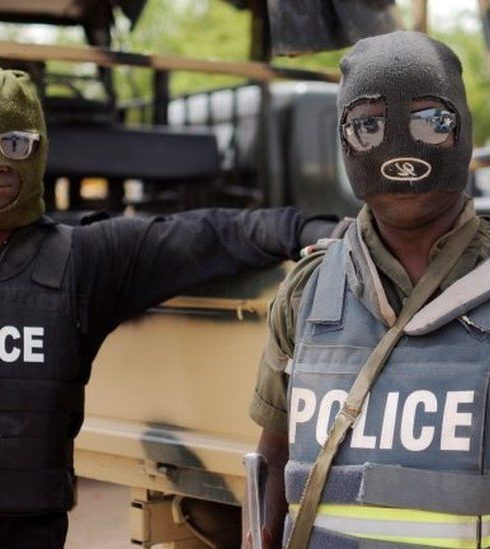
    Some members of Nigerian Police Force -Unknown Solders

    There is an extent to which one may validly believe the images in circulation besides the fact that they are real. For instance, how does one explain the wearing of facial masks (not clinical nor gas masks) by security personnel of the State? How about the gangster-like dressing by a known inspector of police while on duty on a Federal Highway as reported by Punch Newspapers? See https://punchng.com/dressed-to-kill-sars-operative-faces-police-panel/. That leaves one wondering why disguising and hiding of faces has become the characteristic of security agencies that are supposed to serve the people while expecting the people to trust them. Is disguising the new way of evading being caught in the act of committing crimes; and by extension, has “unknown gunmen” become the new though familiar language to explain away violent acts and killing of innocent civilians perpetrated by the state’s security agencies? These questions may be curious at best, but many people have been expressing their doubts, at least in the Southeast, that the bloodletting being put on IPOB are actually committed by IPOB. Plus, there have been a number of intelligence leaks that suggest that the Nigerian Military Intelligence under Buratai had created fake and shadow groups to act as IPOB since 2018 in order to blame IPOB for violent crimes in the Southeast. The Nigerian government has a lot of explaining to do, because we have heard this “unknown […]” language before. And like Fela Kuti, the Nigerian citizens have every reason to lay the blame of the crimes of the so called “unknown gunmen” at the feet of the present regime.

    *Dr. Austin Okigbo teaches ethnomusicology and African Studies at the University of Colorado, Boulder. He is a member of the Africa Security Studies Group.

  • Masked Images of Buhari on International Media

    Masked Images of Buhari on International Media

    It is no longer unusual to see images of world leaders with face masks as measures to stem the spread of the novel coronavirus disease. We see these images however when given world leaders are pictured in the context of news related to the COVID-19. For instance, a quick google image search on President Joseph Biden on COVID-19 pro- duces results of multiple images of him with face masks, but a similar search on news on Afghanistan al- most never shows him with a face mask. This clearly is what happens in photojournalism  relevant images for specific news items.

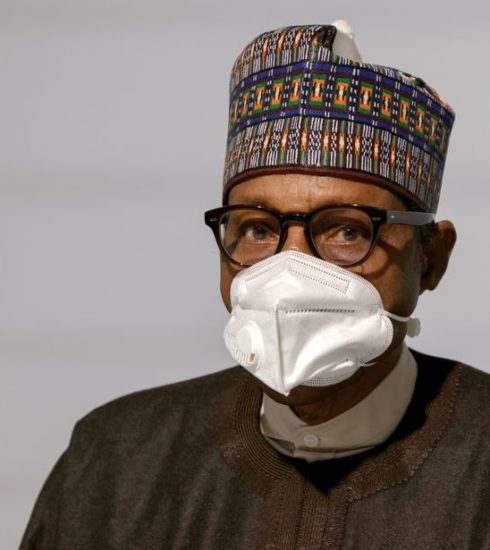
    However, anyone who is following the patterns of recent re- porting on Nigeria especially as it pertains to President Muhammadu Buhari by Associated Press and Reuters would have noticed that he is shown almost always with face mask even when the news item is unrelated to public health. An example is the reportage by Reuters on Wednesday August 25 with the title “Nigeria Signs Military Cooperation Agreement with Russia” (https://www.reuters.com/ world/nigeria-signs-military-co- operation-agreement-with-rus- sia-2021-08-25/).

    Reuters used masked image of the president of Nigeria with hardly any executive context to it. In the same news item however, his Russian counterpart Vladimir Putin is shown in executive and authority context in black suits and on a press briefing podium, albeit without a face mask. Noticing this media trend got me thinking whether the intentional news media use of the masked images are veiled references to a president who is known to have become notoriously mum while the country he leads is falling apart under the weight of insecurity; economic depression; increase in brain drain; the collapse of the educational system; crumbling health infrastructure, an area he promised to tackle by putting a stop to medical tourism overseas, but has since become the number one health tourist himself. He has also become increasingly compromised in corruption which he made his number one priority during the campaign that brought him to power in 2015. Mr. Buhari’s deafening silence over innumerable unfortunate incidents of national concern has even been noted in foreign media reportage on Nigeria and his presidency. Nigerians at large have wondered why this president finds it difficult to address the nation and stay transparent with the citizens. His silence over national issues even got a special line in one of Nigeria’s pop artists, Sparkle Tee’s comic music video, “Talk Something” in 2020 in which he described the president with a mere gesture by holding his lips tight with his two hands and muttering “Uhm Uhm Uhm Uhm Uhm Uhm.” Is it, like Chimamanda Ngozi Adichie has observed, that it is well below him for Buhari to level with the citizens of Nigeria? When he speaks at all, he often either misses the opportunity to address burning issues, or he heaps insult on the “lazy youth” (to use his words), or still stir controversy with serious international and economic reverberation such as his “dot-in-circle” comment which led to a fallout with the microblog tech company Twitter. Perhaps then, a mute Buhari is better than a Buhari who addresses the nation with frequency.

    President Muhammadu Buhari

    On the other hand, however, might it be possible that Mr. Buhari’s style of governance in silence is intentional so as not to betray any hidden agenda? During his 2015 campaign and subsequently, his political opponents accused him of having a hidden Islamist agenda. Conservative media in the USA warned against allowing him to get on the seat of the country’s presidency. These were regarded then as conspiracy theories. Well, six years as president, it is becoming clearer that there is truly a seeming Fulanization and Islamization agenda. At least former President Olusegun Obasanjo, probably the most respected voice on foreign affairs from the continent has said so. Same as Rtd. General Theophilus Danjuma, and both are on record on the so-called agenda.

    Just less than 24 hours ago as at the writing of this article, Kunle Olawunmi, a Rtd. Navy Commodore and Professor of Global Security Studies who has been in the inner circle of Nigeria’s military intelligence spilled it all out on Sunrise, a news program on one of Nigeria’s national television stations, Channels TV, hosted by Chamberlain Usoh. According to him, some governors, ministers, senators, and bureau de change operators who are largely northern Fulani Muslims are sponsors of Boko Haram and the government knows them. He further alleged that the president as commander in chief knows exactly what is happening, but he is quiet. According to him, the rot of the fish begins from the head; meaning that Mr. Buhari is implicated in the whole alleged Islamization agenda. A serious allegation at worse!

    President Vladimir Putin

    Given this scenario, therefore, and the reality of mounting national challenges, is an expectation by the Nigerian people of their president to level with them and speak to them more often an illusion? Of course, citizens of any nation need a leader who inspires them, even if by ordinary address to the nation. Unfortunately, the people won’t get that in a man who has become so unpredictable in his style of governance in silence, whereby media images of him in face masks have become a symbol of his presidential muteness, albeit with damning consequences for the country, the West African region, and the world.

    Austin C. Okigbo teaches Ethnomusicology and African Studies at University of Colorado at Boulder, USA. He is a member of the Africa Security Studies Group

    Twitter handle: @aokigbo