Tag: african

  • South Africa

    South Africa

    SOUTH AFRICA

    South Africa is located at the southern point of Africa. During the seventeenth century, Dutch colonists from the Netherlands (known as Boers) settled there. Over the next 200 years, British, French, and German settlers joined them. At first, they settled along the coast, but eventually settlers moved inland. These settlers developed a unique cultural identity and language and became known as Afrikaners. Their language, Afrikaans, began as a spoken dialect, but developed into a written language, too. Over the next 300 years, the Afrikaners battled indigenous (native) African peoples. established independent republics in the interior, and fought the British in two wars known as the Anglo-Boer Wars. All territories were finally united on May 31, 1910, to become the Union of South Africa. (The Republic of South Africa was established fifty years later on May 31, 1960). In 1910, there was a clear division between the Afrikaners (who belonged to Afrikaner political parties, spoke Afrikaans, supported Afrikaner cultural and linguistic endeavors, and belonged to one of the Dutch Reformed Churches) and British-oriented, English-speaking South Africans. In 1948 the Afrikaner-based National Party came to power. Under a strong religious philosophy and racist social policy, the National Party started to implement the system of apartheid. Apartheid separated the people of South Africa by law along color lines. By the 1980s, there were many Afrikaners who joined the effort to do away with apartheid.

    Food in Our Culture

    The everyday meal of the Afrikaner is characterized by an emphasis on meat, starch, and cooked vegetables. Green or fresh salads are rare. Breakfast features some kind of porridge. Away from the coast, Afrikaners learned from the native peoples to make a gruel called stywe pap or putu pap (stiff porridge or putu porridge). It is common to have this porridge for breakfast with milk and sugar, and also to eat it with meat or boerewors (boer sausage, made of beef and pork) at a braai (barbecue). Venison has always formed part of Afrikaner dishes, as grazing animals could be hunted or culled from national parks. Sosaties (skewered marinated meat similar to shish kebab) is frequently included in a braai . A recipe for bobotie , another favorite dish accompanies this article. Fish has become popular for those living near the ocean. Two foods from pioneer days are still popular among Afrikaners: beskuit and biltong . Beskuit (rusks) are biscuits that have been oven-dried. They are served with coffee. Biltong are strips of dried meat (traditionally, beef or venison; more recently, elephant and ostrich). The biltong are treated with salt, pepper, and spices prior to drying.

    Potjiekos

    Marriage in Our Culture

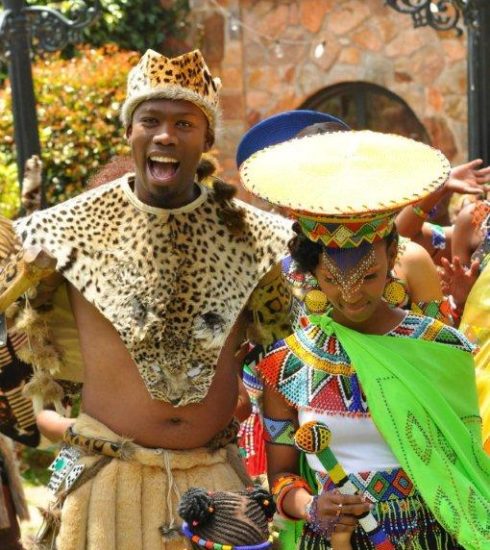
    Pre-Christian marriage in black communities was based on polygyny and bridewealth, which involved the transfer of wealth in the form of livestock to the family of the bride in return for her productive and reproductive services in the husband’s homestead. Christianity and changing economic and social conditions have dramatically reduced the number of men who have more

    than one wife, although this practice is still legal. Monogamy is the norm in all the other groups, but divorce rates are above fifty percent and cohabitation without marriage is the most common domestic living arrangement in black and Coloured communities. Despite the fragility of marital bonds, marriage ceremonies are among the most visible and important occasions for sociability and often take the form of an elaborate multisited and lengthy communal feast involving considerable expense.

    Source: Everyculture

  • Eritrea

    Eritrea

    The term “Eritrea” derives from Sinus Erythraeus, the name Greek tradesmen of the third century B.C.E. gave to the body of water between the Arabian Peninsula and the Africa continent (now known as the Red Sea). Later, during the Roman Empire, the Romans called it Mare Erythraeum, literary meaning “the red sea.” When Italy colonized a strip of land along the Red Sea in  1890, they gave it the name Eritrea. British forces liberated Ethiopia from the Italian colonizers and took control of Eritrea in 1941. Eritrea was administered by the British Military Administration until 1952 when the United Nations (UN) federated Eritrea with Ethiopia. Ethiopia soon violated the federal arrangement, however, and in 1962 Ethiopia annexed Eritrea as its fourteenth province. The year before the annexation, the Eritrean armed resistance against Ethiopian rule commenced. It would take thirty years of liberation war before the Eritrean People’s Liberation Front managed to oust Ethiopian forces from Eritrean soil, one of the longest wars of liberation in Africa. In 1993 the Eritrean people voted overwhelmingly in favor of independence in an UN-monitored referendum.

    Although the Eritrean Constitution recognizes all nine ethnic languages in the country as equal, the government of Eritrea has two administrative languages: Tigrinya and Arabic.

    Tigrinya is a Semitic language also spoken by the Tigreans of Ethiopia. Arabic was chosen to represent the low-land Muslim groups in the country. Nevertheless, only one ethnic group, the Rashaida, has Arabic as a mother tongue, whereas the other groups use it as a religious language. The majority of the population are Tigrinya-speakers.

    Tigrinyan People

    The highland Tigrinya ethnic group is the dominant group, numerically, politically, and economically. There is also a minority group of Tigrinya- speaking Muslims called Jeberti in the highlands. The Jeberti, however, are not recognized as a separate ethnic group by the Eritrean government. The lowland groups—the Afar, Beja/Hadarab, Bileyn, Kunama, Nara, Rashaida, Saho, and Tigre—are all, with the exception of the Tigre, relatively small and, taken together, they do not form any homogenous cultural or political blocs.

    The Eritrean capital, Asmara, is located in the highland plateau, the home region of the biggest ethnic group, the Tigrinya.

    Food in Our Culture

    Eritrean cuisine is a reflection of the country’s history. The Injera is commonly eaten in rural areas. It is a pancake-like bread that is eaten together with a sauce called Tsebhi or Wat. The sauce may be of a hot and spicy meat variety, or vegetable-based. In the urban centers, one finds the strong influence of Italian cuisine, and pasta is served in all restaurants. The lowland groups have a different food tradition than the highlands with the staple food being a porridge (aside from in Arabic) made of sorghum.

    Eritrea Bread
    Eritrea Sorghum Porridge

    Both Islam and the Orthodox Chris- tian tradition require rigorous observance of fasts and food taboos. Several periods of fasting, the longest being Lent among the Orthodox and Ramadan among Muslims, have to be adhered to by all adults. During religious celebrations, however, food and beverages are served in plenty. Usually, an ox, sheep, or goat is slaughtered. The meat and the intestines are served together with the injera. Traditional beer (Siwa) is brewed in the villages and is always served during ceremonial occasions.

    Marriage in Our Culture

    Customary rules of marriage vary among ethnic groups. Generally, girls marry at an early age, sometimes as young as fourteen. A large share of the marriages in the rural areas are still arranged by the family groups of concern.

    Generally, people live together in nuclear families, although in some ethnic groups the family structure is extended. The man is the public decision-maker in the family, whereas the woman is responsible for organizing the domestic activities of the household.

    Inheritance rules in Eritrea follow the customary norms of the different ethnic groups. Generally, men are favored over women, and sons inherit their parents’ household possessions.

    The nuclear family, although forming the smallest kin unit, is always socially embedded in a wider kin unit. The lineage and/or clan hold an organizing function in terms of social duties and obligations and as a level of identity. With the exception of the Kunama who are matrilineal, all ethnic groups in Eritrea are patrilineal, that is, the descent is traced through the male line.

    Source: Everyculture.com